
The Reiki Ideals · Reiki Precepts
The Five Reiki Principles
The Reiki ideals, as I was taught them in the Usui Shiki Ryoho tradition. Just for today.
What are the five Reiki principles?
The five Reiki principles are a short set of daily intentions that sit at the heart of Reiki practice. You will see them called the Reiki principles, the Reiki precepts, or the Reiki ideals. They are the same five lines. I use the word ideals because that is the word in the lineage I trained in, and I will use it through the rest of this page.
Each one begins with the same three words: Just for today. That phrase is doing quiet, important work, and we will come back to it.
In the Usui Shiki Ryoho tradition, the ideals are where practice begins. Before hand positions, before attunements, before any technique, there are these five lines and the question of how you meet your own day.
The five ideals, in the words I teach
- Just for today, I will let go of anger.
- Just for today, I will let go of worry.
- Just for today, I will give thanks for my many blessings.
- Just for today, I will do my work honestly.
- Just for today, I will be kind to my neighbor and every living thing.
What does “just for today” mean?
It means the ideals are not a lifetime vow, and they are not a standard you pass or fail. They are an invitation for one day, renewed each morning or evening, whichever you choose.
That matters more than it sounds. Most of us can let go of anger or worry for an afternoon. Very few of us can promise never to feel either again, and a promise like that quietly becomes one more thing to feel guilty about. Just for today is a size your nervous system can actually say yes to.
The Reiki precepts, one at a time
For each ideal: what it asks, what it does not ask, and one small way to practice it today.
The First Ideal
Just for today, I will let go of anger.
What it asks
To notice anger when it arrives, and to stop feeding it. Letting go is something you do with what you already feel, not a way of avoiding it.
What it does not ask
It does not ask you to pretend you are not angry, to be endlessly agreeable, or to stay in a situation that harms you. Anger often carries real information. The ideal is about what you do with it next.
Today
The next time anger rises, take one breath before you speak, send, or act. Notice where it lives in your body. Body first, mindset second.
The Second Ideal
Just for today, I will let go of worry.
What it asks
To set down the rehearsing of futures you cannot yet touch. Worry borrows from tomorrow and spends it today.
What it does not ask
It does not ask you to stop planning, stop caring, or stop preparing. Caring about an outcome and being consumed by it are different things.
Today
When a worry loop starts, ask one question: is there a single thing I can do about this right now? If yes, do it. If no, bring your attention back to what is in front of you, your hands, your breath, the room.
The Third Ideal
Just for today, I will give thanks for my many blessings.
What it asks
To look at what is already here and name it. Gratitude is a practice of attention before it is a feeling.
What it does not ask
It does not ask you to call hard things good, or to cover grief with a smile. You can be thankful for the warm cup in your hands on a day that is otherwise heavy.
Today
Before the day ends, name three specific things. Small and concrete works best: the light through a window, a message from a friend, a meal you did not have to cook.
The Fourth Ideal
Just for today, I will do my work honestly.
What it asks
To bring integrity to whatever your work is today, whether that is a job, caregiving, creating, or running a home. That includes being honest with yourself about what you are doing and why.
What it does not ask
It does not ask for perfection or overwork. Honest work and exhausting work are not the same thing.
Today
Choose one task and do it fully, without a shortcut you would have to hide. Then notice how it feels to have nothing to hide.
The Fifth Ideal
Just for today, I will be kind to my neighbor and every living thing.
What it asks
To extend kindness past the people who are easy to be kind to, to animals, to the living world, and to strangers. It is worth remembering that you are a living thing too.
What it does not ask
It does not ask you to be a doormat. Kindness is not compliance, and a boundary held gently is still kind.
Today
Offer one deliberate act of kindness that nobody will see or thank you for. Let it be small.
How to practice the Reiki ideals
There is no single correct way, and you do not need any special setup. Here is one simple way to begin.
Choose a moment you already have, like the first minutes of the morning or the last minutes before sleep. Read the five lines slowly, out loud or silently. Rest your hands on your chest or belly if that feels settling. Then pick the one ideal that is asking for the most attention today, and carry that one through the day.
If you already practice self-Reiki, the ideals can be a natural place to begin or end that time. If you do not, they stand perfectly well on their own.
Who is sharing these with you

Carissa Andrews · Reiki Master & Teacher
I'm Carissa Andrews. I was attuned as a Reiki Master and Teacher in the Usui Shiki Ryoho tradition on June 21st, 2008, and I teach live Reiki I & II certification through Sovereign Light.
You can read more about me and how I got here on my about page.
Where the ideals come from
I received the ideals as part of my Usui Shiki Ryoho training, and I teach them the way they were given to me. For the full line of teachers I trained through, with the documents behind it, see my Usui Reiki lineage page.
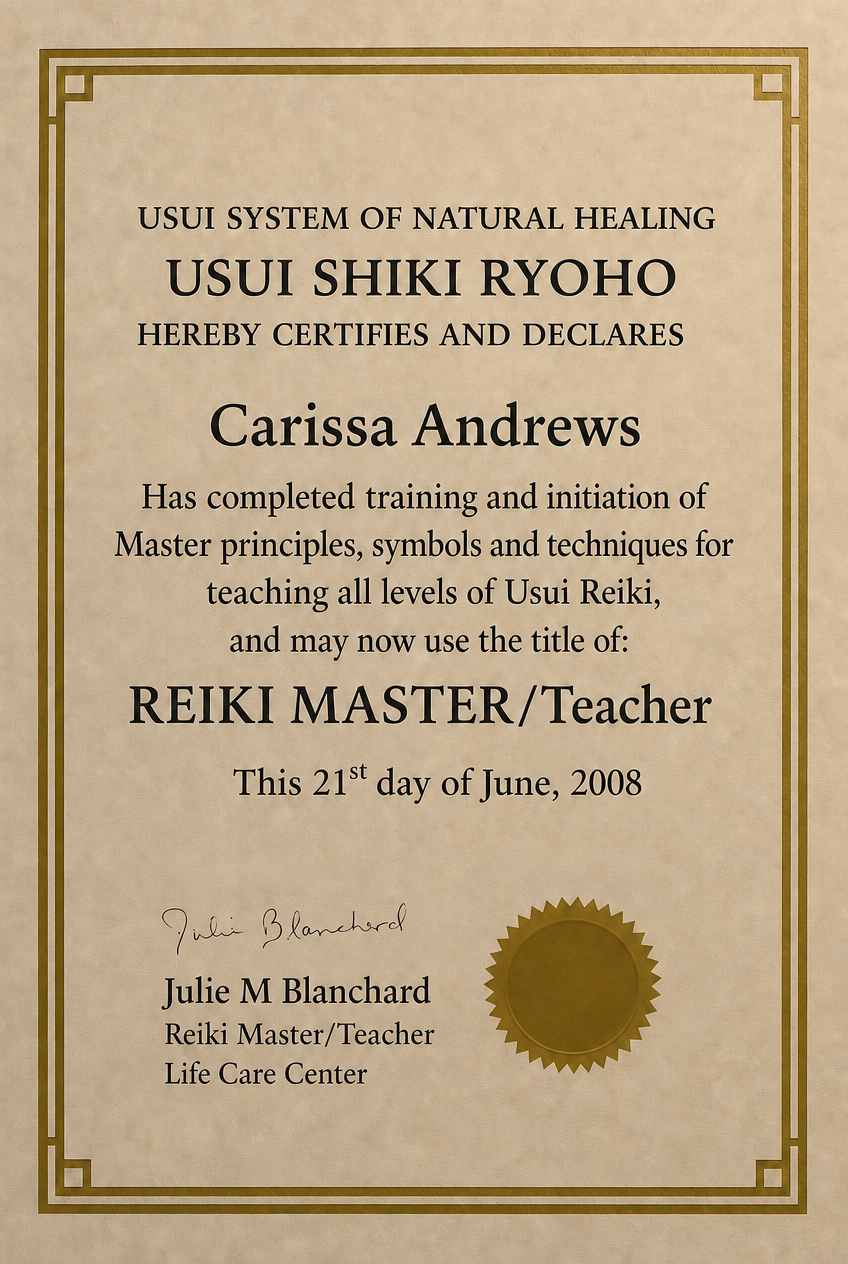
Usui Shiki Ryoho · Reiki Master & Teacher · June 21, 2008
Signed by Julie M Blanchard
Questions people ask
Are the Reiki precepts and the Reiki ideals the same thing?
Yes. Principles, precepts, ideals, and sometimes “the five rules” all point to the same five lines. Different teachers and traditions favor different words. I say ideals because it is the word in my lineage.
Do I need to be attuned to practice the ideals?
No. The ideals are a daily practice anyone can take up, and you don't need an attunement to live by them. You also don't need to be attuned to receive Reiki. Attunement is only part of learning Reiki, for those who want to practice it as a practitioner.
Are the Reiki ideals a religion?
No. They do not ask you to adopt a belief or join anything. They are five short intentions about how you meet your day, and people from many backgrounds and traditions can practice them alongside whatever they already hold dear.
Are the ideals the same as a Reiki mantra?
The five lines are often spoken aloud as a daily reminder, which is why they are sometimes searched for as a Reiki mantra. In my teaching they are best understood as intentions to live, rather than words with a special power of their own.
What if I miss a day, or break one of them?
Then you begin again tomorrow. That is the whole point of just for today. There is no streak to protect and nothing to make up.
Where to go from here
The ideals are the first step of Reiki practice, not the last. If you feel called to go further, here are a few doors.
- Learn Reiki with me. Sovereign Light is live Reiki I & II certification in the Usui Shiki Ryoho tradition, offered in cohorts. Join the waitlist to hear when the next one opens.
- See the line behind the teaching. The Usui Reiki lineage page walks through each teacher, in full.
- Practice letting go. If the first two ideals are the ones asking for you today, Return to Flow is a gentle place to continue.
- Read the difference. Reiki Activation vs. Verbal Reiki: What’s the Difference?
More about who I am and how I got here →
Reiki is a practice of energetic support and is not a substitute for medical or psychological care. No specific outcomes are promised or guaranteed. Certification reflects completion of training within the Usui Shiki Ryoho system.