Inanna · Ishtar · Sumerian Goddess · The Seven Gates · Manifest Differently
InannaQueen of Heaven and the Descent Through the Seven Gates
The oldest story we have of going down, and finding the way back.
Who was Inanna?
Inanna was a goddess of ancient Mesopotamia, honored in Sumer as the Queen of Heaven. She was tied to love, to war and to fertility, and her city was Uruk, where her great temple stood. She was also linked to the planet Venus, the morning and evening star, which appears at the edge of night and day.
She is a goddess of thresholds, and the most famous story about her is the one where she crosses the greatest one: she goes down into the underworld, and she comes back.
This page gathers what I have learned about her, how I came to walk with her, and the activations I have recorded in her name.
Inanna at a glance
A few things worth knowing before the story.
Queen of Heaven
One of her best-known titles, used in Sumer for centuries.
Inanna and Ishtar
Inanna is the Sumerian name. Ishtar is the later Akkadian, Babylonian and Assyrian name for the same goddess, with overlapping stories.
Her city
Uruk, in southern Mesopotamia, where the Eanna temple was dedicated to her.
Her star
Venus, the morning and evening star. Sumerian texts also call her the First Daughter of the Moon.
Her stories were first written down in Sumerian, in cuneiform, on clay tablets.
Enheduanna, the first author known by name
Around 2300 BCE, a woman named Enheduanna served as high priestess at Ur. She was a daughter of Sargon of Akkad, and she is the earliest author in history known by name.
She wrote hymns to Inanna, including the one often called the Exaltation of Inanna, in which Inanna is praised as a goddess of enormous power. Many scholars see her work as one of the reasons Inanna rose so high in the religious life of the region.
The Descent of Inanna is a separate poem, known from clay tablets copied by ancient scribes, and no author is named on them. It matters here because the first named writer in history chose Inanna as the one to write about.
The descent
In the Sumerian poem, Inanna, queen of heaven and earth, turns her attention to the Great Below, where her sister Ereshkigal rules. She prepares herself, dresses in her regalia, and tells her trusted companion Ninshubur what to do if she does not return.
At the first of seven gates, she is stopped. To go further, something is taken from her. The same thing happens at each gate that follows, until she has given up everything that made her recognizable as a queen.
She arrives before Ereshkigal with nothing. She is struck down, and her body hangs on a hook for three days.
What brings her back is not a hero. Two small beings are sent down, and they do nothing but stay with Ereshkigal in her grief and echo it. Because they witness her, she releases Inanna.
The seven gates
What is taken at each gate, and the theme I work with there.
| Gate | What is taken | The theme in my work |
|---|---|---|
| 1 | Her crown | Safety. Releasing the belief that safety has to be earned. |
| 2 | A necklace of beads | Worth. Releasing worth measured by output and pleasing. |
| 3 | A double strand of beads | Shedding false identity. Releasing a self built to be seen and approved of. |
| 4 | Her breastplate | Releasing the need for protection. Letting the heart be seen, and held. |
| 5 | A gold ring at her wrist | Surrendering attachment to outcomes. Speaking without gripping what comes back. |
| 6 | Her measuring rod and staff | Releasing scarcity. Putting down the measuring of what you have against what is missing. |
| 7 | Her royal robe | Embracing authenticity. The last performance of who you have to be to be received. |
The objects come from the myth, and translations vary in some details. The themes are my own map of the work, shaped by years of walking the gates myself, and are not a historical reading.
Every gate is walked twice
As Inanna comes back up, she moves through the same seven gates, and what she gave up is returned at each one. She is not the same person who went down. She has been to the place underneath the crown.
The myth does not make the return tidy. The beings who escort her up demand that someone take her place below, and she finds that her husband Dumuzi has been sitting on his throne, not grieving her. She does not climb out unchanged or unpaid, and I find that honest. In the end, Dumuzi is granted half the year above, and his sister Geshtinanna takes his place below for the other half.
It is also why I do not read the story as a straight line. Letting go and receiving happen together at a gate, and once you have walked it, life will ask you to walk it again. It is a spiral, and each time you know the way a little better.
How the story came back
For close to four thousand years, the Descent of Inanna lay buried in the ruins of Nippur, one of Sumer's spiritual centers. Its clay tablets were excavated between 1889 and 1900, then divided between museums in Istanbul and Philadelphia.
Scholars had to read the fragments, match them and reassemble the text over about fifty years, with Samuel Noah Kramer playing a key role. The ending, with Dumuzi and Geshtinanna, was one of the last pieces to be found, on a tablet from Ur.
Diane Wolkstein later shaped Kramer's translations into the retelling in her book, Inanna, Queen of Heaven and Earth. Translations differ in some details, which is why you may see a ring in one version and a bracelet in another.
How I came to Inanna
I went to school to become an archaeologist, and I have loved ancient history, mythology and comparative religion since I was a child. For over a decade I wrote mythology into my novels, and I taught other authors how to publish. Both identities worked, for years.
Somewhere in there, something underneath started trying to come through. It took my businesses cracking, the traction I had built disappearing and the growth stalling out before I stopped trying to fit it inside the old containers. In the middle of that crumbling, I found out I am autistic and ADHD, and it made everything else make sense.
In the summer of 2024, I sat down to meditate on which goddess I was most attached to. Ishtar came up first. She is the later Babylonian version of the Sumerian Inanna, so I started researching, and followed her back to Inanna and the seven gates.
It did not feel like a metaphor I had picked because it was pretty. It felt like a path I was already standing in. My ego death was specific: letting my author and teaching identities crumble, letting the money that came with them fall, and trusting, without proof, that something stronger would be there on the way back up. Inanna gave me the language for what I was already living.
I am not on the other side looking back. I am still returning to gates I thought I had cleared. That is why I build the work gate by gate, the same way I walked it.
Inanna in my activations
Two of them are free on YouTube. The third takes you through all seven gates, and you can have it without joining the Temple.
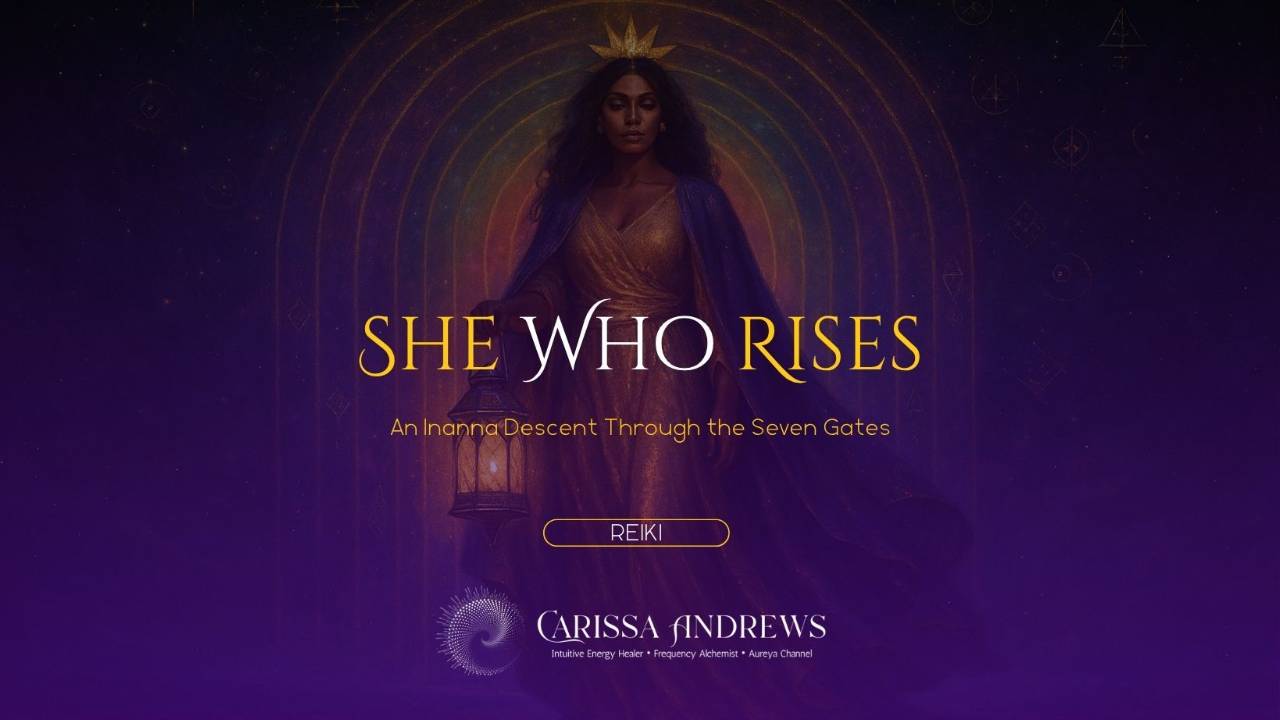
A Single Transmission
She Who Rises
An Inanna descent through the seven gates, as one verbal Reiki activation. If you want to walk all seven gates without joining the Temple of Mysteries, this is the place to begin.
Explore She Who Rises
The First Gate
A 7/7 portal activation with Inanna at the first threshold, where the crown comes off.
Listen on YouTube
The Seven Fires
A 7/7 portal activation with Inanna, and her invitation to the seven gates.
Listen on YouTubeGo deeper
If this stirred something, here are the places the story keeps going.
The Seven Gates of Inanna
The myth and the seven gates in full, with the table of what is released and received at each.
Read the blogWhat Is a Modern Mystery School?
Why embodiment is different from information, and how the Temple works.
Read the blogRead the myth itself
If you would like to read the poems yourself, this is the book I draw on for the myth.
Inanna, Queen of Heaven and Earth
Diane Wolkstein's retelling of the Sumerian poems, shaped from Samuel Noah Kramer's translations, including the descent, with Kramer's essay on how the tablets were found.
See the book on AmazonAs an Amazon Associate, I earn from qualifying purchases.
Where to go from here
Take whichever door feels steady, at your own pace.
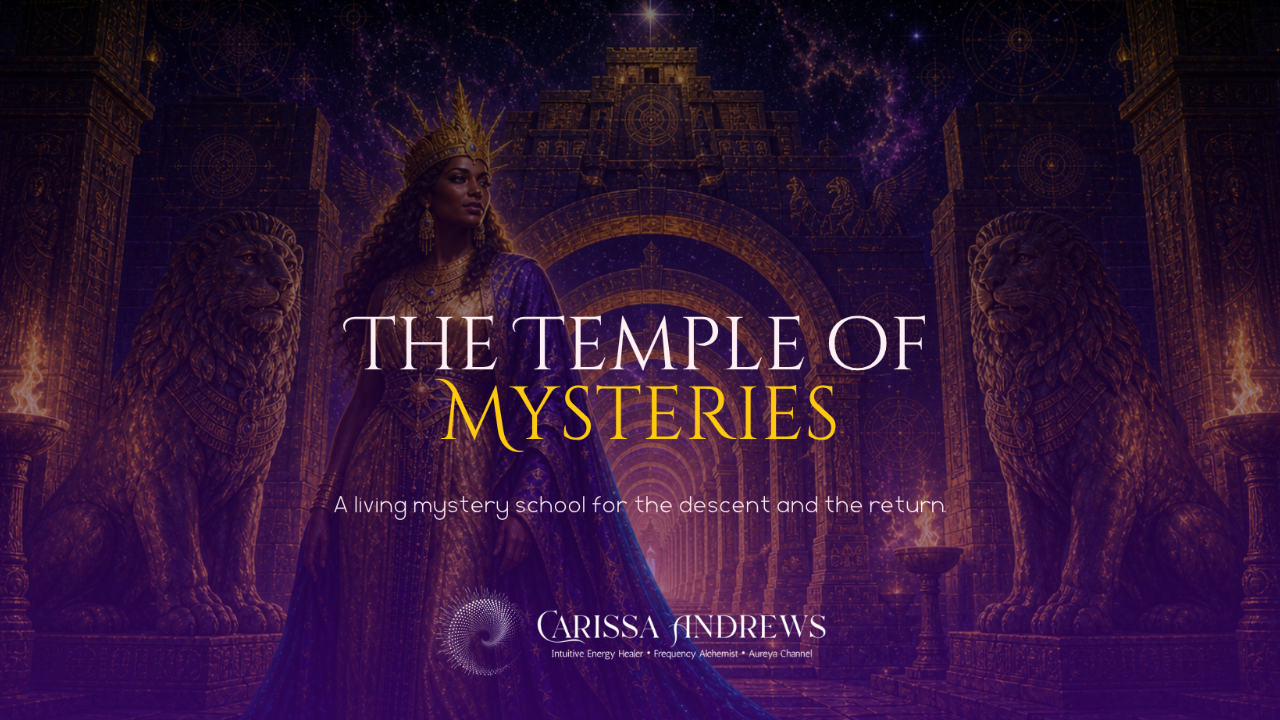
The Ongoing Work
Walk it in the Temple of Mysteries
Temple of Mysteries is a living mystery school built on Inanna's descent. Inside, the seven gates are walked rather than read, with a self-paced path, monthly live circles, and verbal Reiki activations, always in company rather than alone.
Enter the TempleWhich gate are you at?
A short quiz that names the gate you are standing at right now.
Take the Gate QuizFrequently asked questions
Who was Inanna?
Inanna was a Sumerian goddess of ancient Mesopotamia, honored as the Queen of Heaven. She was tied to love, war and fertility, to the planet Venus as the morning and evening star, and to the city of Uruk, where her main temple stood.
What is the difference between Inanna and Ishtar?
Inanna is the Sumerian name. Ishtar is the name used by the Akkadian, Babylonian and Assyrian peoples who came later, and the two are usually treated as the same goddess in different languages and eras. Their stories overlap, but they are not identical, and scholars note differences in how each was worshipped.
Who was Enheduanna?
Enheduanna was a high priestess at Ur, around 2300 BCE, and a daughter of Sargon of Akkad. She is the earliest author known by name in history, and she wrote hymns to Inanna, including the one often called the Exaltation of Inanna. The Descent of Inanna is a separate Sumerian poem, copied by ancient scribes on clay tablets, and no author is named.
What is the Descent of Inanna?
It is a Sumerian poem, known from clay tablets dating to around 1750 BCE, and likely older, in which Inanna travels to the underworld, the realm of her sister Ereshkigal. She must pass through seven gates and give something up at each one. She arrives with nothing, is killed, and is brought back, returning through the same gates.
Why seven gates?
In the poem, there are seven gates, and seven pieces of her royal regalia taken from her. The number seven runs through Mesopotamian thought. The way I map the gates onto the seven chakras, with a theme for each, is my own framework and is not a historical claim.
Do I have to believe in goddesses to use this?
No. You can read the myth as a story about loss and return, and take what is useful. In my activations I call on Inanna by permission, and nothing asks you to believe anything. Receive only what feels right.
Are you claiming a lineage back to ancient Sumer?
No. I am a Reiki Master in the Usui Shiki Ryoho lineage, and I work with Inanna's descent as a map. It is the structure I found myself already walking, and I do not claim an unbroken tradition from ancient Sumer.
Guided by Carissa Andrews, Reiki Master and lineage holder.
Reiki is a complementary practice and not a substitute for medical or mental health care. No specific outcomes are promised or guaranteed. This page is educational and is not therapy or clinical advice.